The diagram below shows the steps involved in column addition for
Note, most of the top digits are smaller than the lower ones. We have done this for demostration purposes as this makes the calculation harder and forces you to 'borrow' from the column to the left.
(If the top digits are all bigger, say 789 - 123 , the calculation is much easier as no borrowing is required.)
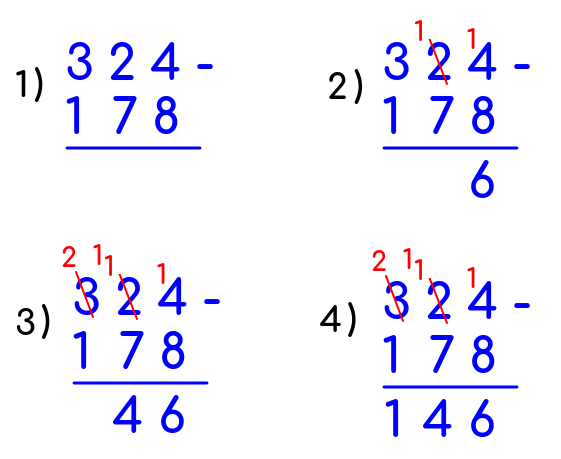
- Write out the subtraction as shown. Use decent-sized digits. Don't try to squash them up to be 'neat' as the carry digits are much smaller than the main digits.
- Four cannot take away 8, so we need to borrow a ten from the column to the left. As such, cross out the two and take one off the value, to give 1. Write 1 to the left of the 2 as show. Now write the "1" you have borrowed to the left of the 4, as shown in red. We now have 14, which can take away 8. This makes 6, so write that in the answer area below the line.
- Next, 1 cannot take away 7, so we need to borrow again. Cross out the 3 and change it to a two, shown in red. Now add the "1" you borrowed to the "1" to the right, making 11 ( shown in red. ) Now, 11 can take away 7, so write the answer, 4, in the answer area below.
- Finally, 2 can take away 1, so write the answer 1 in the answer area, giving a result of 146.
Note This method has a drawback: It becomes very difficult to do when there are zeros, especially multiple zeros, on the top number. In this case a different method is needed, where the 'borrowings' take place on the lower number ( technically called the subtrahend. )
Note: It is extremely unlikely a subtraction requiring this technique would be given on a foundation GCSE paper, but it's still well worth knowing:
Example: How to subtract
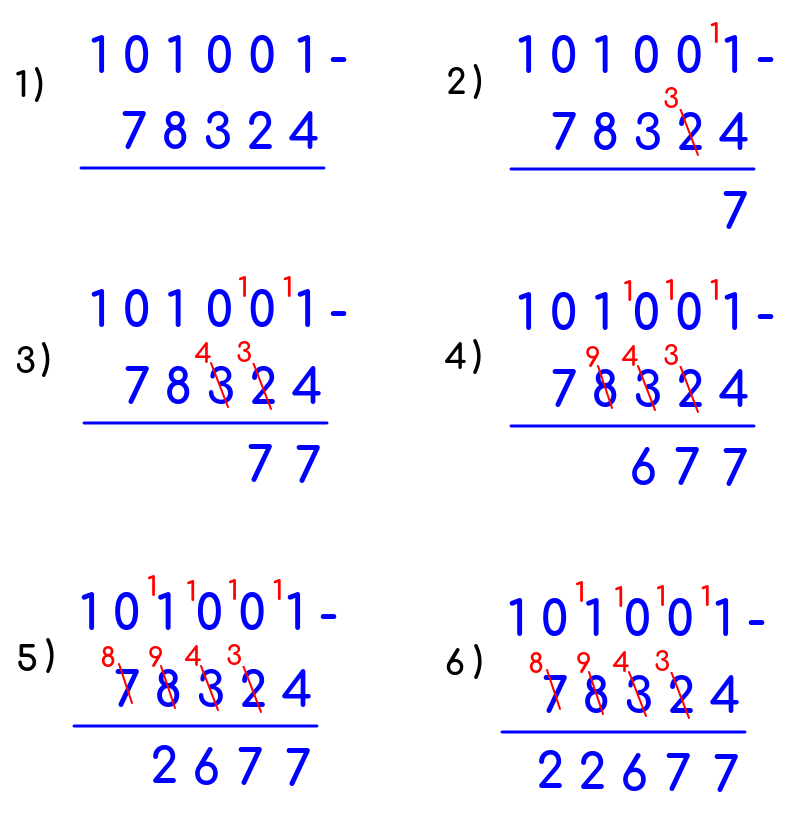
- Write out the subtraction as shown. Use decent-sized digits. Don't try to squash them up to be 'neat' as the carry digits are much smaller than the main digits.
- 1 can't take away 4, so borrow a 1 and write it above to make 11 ( shown in red.) Now this time, add 1 to the next digit to the left on the bottom row, to make 3 - cross the 2 out and write 3 above, shown in red. 11 can now take away 4, so write the answer below ( 7 . )
- Next 0 can't take away 3, so borrow a 1 and write it at the top left of the zero, making ten. Now, cross out the bottom 3 and add 1, making 4. write the 4 in as shown in red. 10 can now take away 3, so write the answer ( 7 ) in the space below.
- Next, we have another zero that can't take away our new 4 below. So again borrow a 1 and write it in above, making 10, shown in red. Again, add 1 to the bottom digit to the left, so cross out 8 and write a 9 above, shown in red. 10 can now take away 4 so write the answer 6 below.
- Next, 1 can't take away the 9 below so adjoin a borrowed 1, making 11, show in red. Cross the 7 out in the bottom number digit to the left, and write in 8 instead. Now, 11 can take away 9 so write the answer 2 below.
- Lastly we don't need to bother doing any more borrowings as the zero above automatically 'borrows' the 1 to the left, making 10. 10 take away 8 is 2, so write that below. The final answer is 2267.
Difficulty levels:
Level 1:
5 9 -
1 9
Level 2:
4 4 6 3 -
  1 5 7
Level 3:
2 2 2 0 1 2 -
  4 1 7 9 6