For schools in England, paper multiplication is usually taught one of three ways:
- Column method
- Window method
- Napier's Bones / Chinese method / Rainbow method
In general, Column is the fastest, Window is the easiest to understand what's going on, and Napier's Bones is usually the one least prone to mistakes. In a paper (non-calculator exam, ) it's usually best to choose two methods. Do it twice and compare answers. If they are different you know one has as a mistake.
Note the last method goes by many different names, and this will vary from school to school! The "Napier's Bones" name comes from John Napier, the inventor of logarithms. Back in the day, paper was super expensive so merchants carried a bag of calculating tools, effectively animal bones carved into long square-shaped rods. These rods would have had a bunch of ready-made digit calculations on that could be 'lined up' to perform the same long multiplication as is now done on paper, described shortly.
Column multiplication
The following diagram below shows the steps involved in column multiplication n for
Note that by convention the number with the smallest number of digits goes on top ( it doesn't have to, but is generally easier. ) Note also there are two different ways to proceed. Either do the top digits one at a time, or do the bottom digits one at a time. In this example, we do the top digits one at a time; in other words, multiply each top digit by all bottom digits before moving to the next top-level digit.
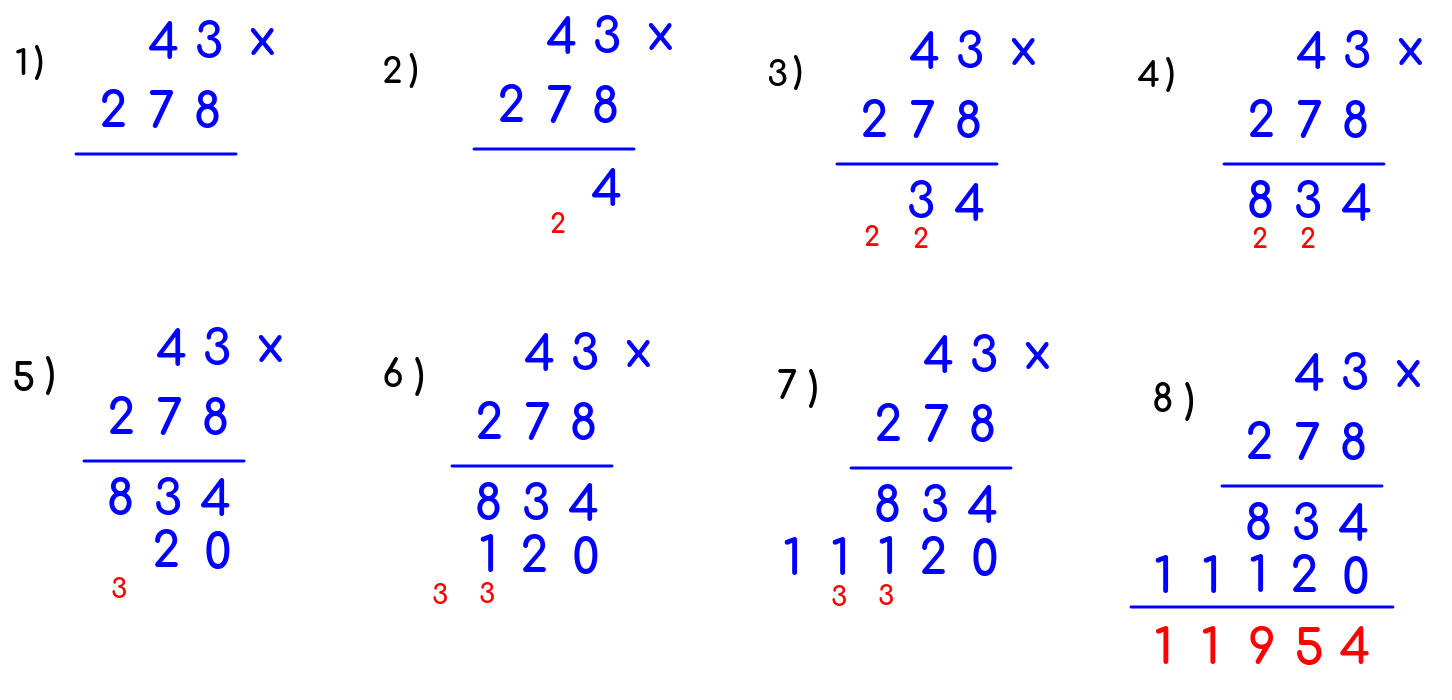
- Write out the multiplication as shown. Use decent-sized digits. Don't try to squash them up to be 'neat' as the carry digits are much smaller than the main digits.
- 3 times 8 is 24. Write the 4 in big and the 2 as a carry, under the next column position ( shown in red. )
- 3 times 7 is 21, plus the 2 carry makes 23. Write the in big ( shown in blue ) and the carry , 2, underneath the next column position.
- 3 times 2 is 6, add the carry of 2 makes 8. Write the answer 8 in big underneath.
- Now add a zero underneath. This is because the next top digit you are multiplying is in the 'tens' column so represents a multiple of 10. Now multiply the 4 by the 8 to give 32. Write the answer 2 in big, and the carry 3 in small ( shown in red.)
- Multiply the top 4 by the lower 7 to give 28. Add to the carry of 3 gives 31. Write the answer 1 in big as shown, and the carry 3 in small under the next column, shown in red.
- Now multiply the top 4 by the lower 2 to give 8. Add to the carry 3 to give 11. As this is the last multiplication step, just write the answer 11 in directly.
- now add up the two answer rows to give a total.
Note, if the top number had been three digits long, then two zeros would be required.
Window multiplication
The following diagram below shows the steps involved in column multiplication for
Note that by convention the number with the largest number of digits goes on the top ( it doesn't have to, but is neater and takes up less room on paper. )
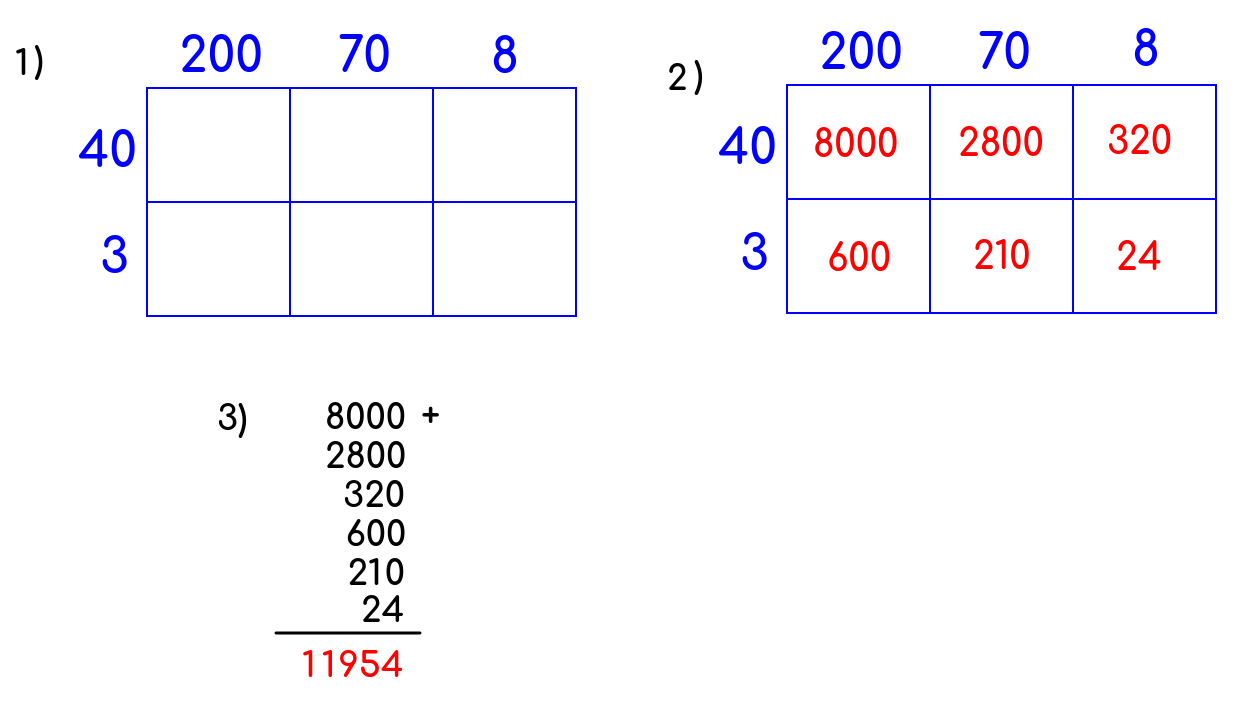
- Write out the multiplication as shown. Use decent-sized digits. Don't try to squash them up to be 'neat' as the carry digits are much smaller than the main digits. The digits to be multiplied are multiplied by their column position value. This just involves putting zeros on the end. So for 278, the 2 is written as 200 as it is in the hundreds column, the 7 is written ass seventy as it is in the tens column and the 8 remains just 8.
Similarly, for 43, the 4 is written as 40 as it is in the tens column ( effectively, the '4' in 43 actually means '40.') - Perform the multiplication of each row and column value and write it in the box. This isn't as hard as it looks - it's basically just your normal times tables but adding zeroes to the answer. You add the same number of zeros as there are in the numbers being multiplied. So for example, for
40 × 70 You would just do 4 × 7 = 28, and add two zeros, one for the 40 and one for the 70.
Note also it makes no difference as to the order in which you work out these box values. - finally, take all the numbers you have multiplied in the boxes, and add them together for the final result.
Napier's Bones multiplication
The following diagram below shows the steps involved in the Napier's Bones multiplication for
Note that by convention, just as with the window method above, the number with the largest number of digits goes on the top ( it doesn't have to, but is neater and takes up less room on paper. )
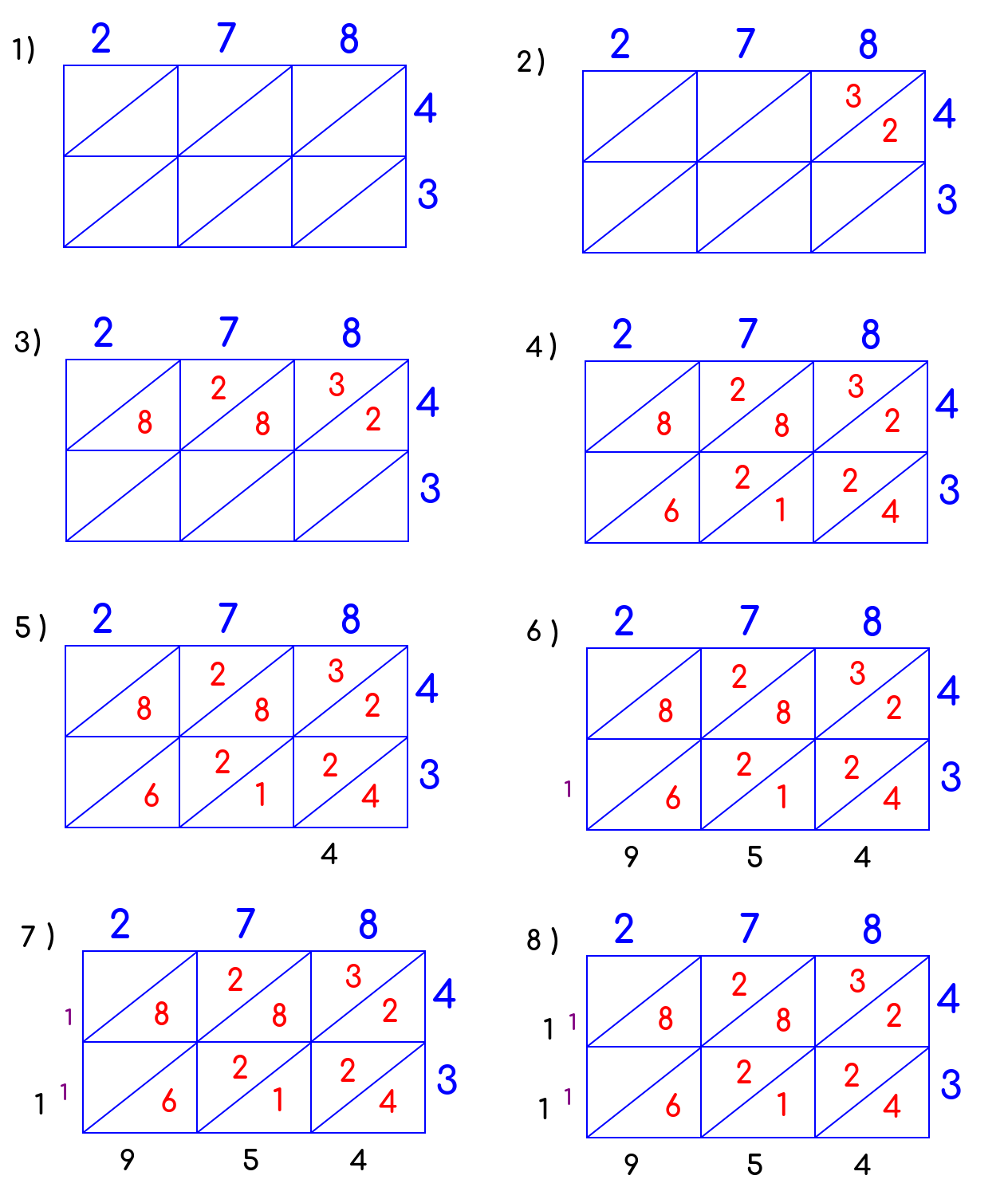
- Write out the multiplication as shown. Use decent-sized digits. Don't try to squash them up to be 'neat' as the carry digits are much smaller than the main digits. The thing that most beginners get wrong is drawing the diagonals. These go top-left to bottom-right. It takes a bit of practice to get this right so don't be put off if it goes wrong the first few times you try this.
- Multiply the 8 by the 4 to give 32. Every time you do this, the most significant digit ( the 3 ) goes on top of the diagonal, and the lowest ( the 2 ) goes underneath.
- Multiply the 7 by the 4 to give 28. The '2' here is the most significant,
because really it means 20, so put the 2 above the diagonal and the 8 below.
Next multiple 2 by 4. This gives 8, a single digit with no more significant digits, so just write the 8 below the diagonal as shown. - Do the same thing for the bottom row to complete the grid.
- Next, beginning on the bottom right, you 'slide down' the diagonals and add up the digits as you go, writing the answer underneath. The first answer is just 4, as there are no other digits on its diagonal to add.
- Next slide down and add up the 2, 2 and 1 to make 5, and write it underneath.
Now slide down and add up the 3,8,2 and 6. This makes 19, so write the least significant digit, the 9, underneath as the answer. Put the carry ( 1) to the left of the next diagonal exit point, shown in purple. - Next slide down and add up the 2, the 8 and the carry of 1 to make 11. Write the 1 as the answer and put the carry above ( also shown in purple.)
- Lastly, slide down the top diagonal; there is nothing there except
the carry, so write the carry as the answer 1.
Now you have the answer, reading top-left to bottom-right: 11954.
Difficulty Levels:
Level 1:
7 9 ×
2 5
Level 2:
1 4 6 ×
9 2 2
Level 3:
  8 6 6 ×
7 9 9 8